How a literary controversy forced writers, judges and one of the Commonwealth’s biggest prizes to confront a disturbing new question: how do you prove that a story was written by a human?
What began as a question about literary merit quickly became something more unsettling: a public investigation into whether a prize-winning short story had been written by a human at all.
The controversy surrounding the 2026 Commonwealth Short Story Prize began to gather momentum on May 16, when Nigerian writer and critic Chimezie Chika questioned the selection of Jamir Nazir’s The Serpent in the Grove as the Caribbean regional winner. His criticism was initially about the story itself, its quality, its style and how it had emerged successful from a major literary competition.
But as readers returned to the story, another conversation began to take shape.
Some found aspects of the prose strangely familiar. Certain sentence structures, rhythms and stylistic habits reminded them of language produced by generative artificial intelligence. By the following day, writer Ope Adedeji was already noting that people responding to the discussion were describing the story as giving them “AI vibes”.
The suggestion might have remained another speculative argument on literary X. Instead, it escalated.
On May 18, AI researcher and entrepreneur Nabeel S. Qureshi published a more direct critique, arguing that the story contained linguistic patterns he associated with ChatGPT-generated writing. The question had suddenly shifted. Readers were no longer debating whether the story deserved to win. They were asking whether the person named as its author had written it at all.
That distinction transformed the controversy.
Soon, excerpts from the story were being dissected publicly. Readers highlighted recurring constructions and phrases they regarded as suspicious. AI detection tools were brought into the discussion, and writer Tuhin Chakraborty posted that Pangram, one such detector, had assessed the story as entirely AI-generated.
The result travelled rapidly across X.
It was an irresistible premise for the internet: a prestigious literary prize, a winning short story and an algorithm apparently accusing another algorithm of having written it.
Yet beneath the spectacle was a more complicated problem. AI detectors do not establish authorship with certainty. They make probabilistic assessments based on patterns in language, and those assessments can produce false positives. Human writing can be flagged as artificial, particularly when it is highly polished, formulaic or stylistically repetitive. Conversely, AI-generated prose can sometimes pass unnoticed.
Nevertheless, the investigation on social media widened.
Other Commonwealth Prize stories were tested. Judges’ comments were scrutinised. Writers and readers began searching not simply for bad prose, but for what they believed to be the fingerprints of artificial intelligence.
Pangram itself eventually entered the conversation, announcing that it had examined Commonwealth Short Story Prize winners going back to 2012 and identified additional stories it believed displayed signs of AI generation.
By then, the controversy was no longer about Jamir Nazir alone.
It had become a much larger argument about literary authenticity in the age of generative AI.
The Commonwealth Foundation responded by opening an investigation into the allegations. In doing so, it confronted a problem that literary institutions will increasingly have to face: how does a writer prove that a piece of writing is genuinely theirs?
For generations, literary competitions have judged what appears on the page. Now, the process behind the page may matter almost as much.
The Foundation examined working drafts, time-stamped documents, writers’ notes and other material connected to the creation of the shortlisted and winning stories. The authors were asked, in effect, to reconstruct the history of their own writing.
Drafts became evidence.
Revision histories became evidence.
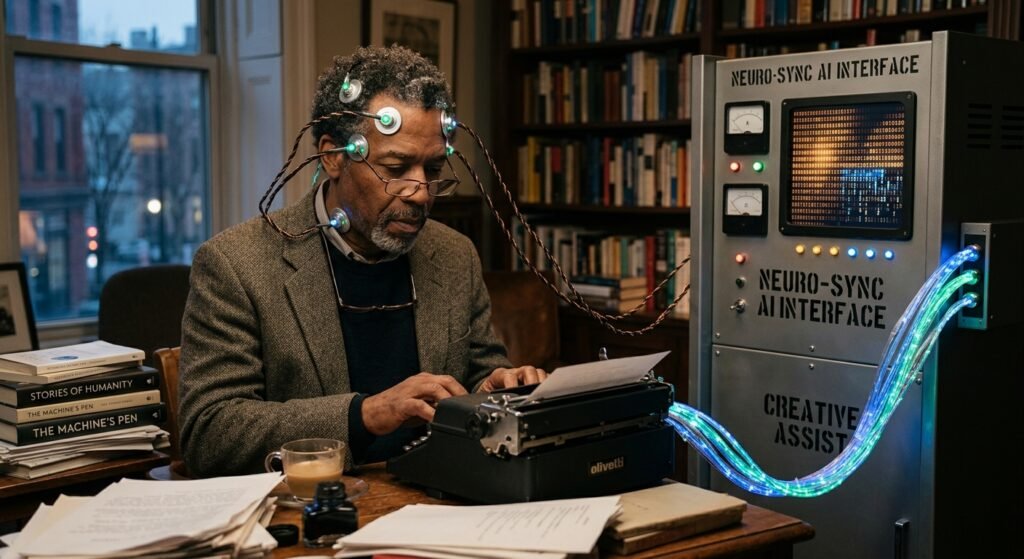
The messy process of writing, once largely private, had acquired a new function: it could serve as proof that a human imagination had been at work.
After reviewing the material, the Commonwealth Foundation reached a conclusion that complicated the narrative that had taken hold online. It said it was satisfied that artificial intelligence had not been used to write the winning stories.
The writers had effectively been cleared.
But the controversy had already exposed a deeper problem.
Generative AI has altered the relationship between readers and written language. A sentence that feels too polished can now attract suspicion. Repetition can be treated as evidence. A familiar metaphor or predictable construction can provoke questions about authorship that would have been unthinkable only a few years ago.
The burden has begun to shift.
In the past, writers primarily worried about plagiarism: the accusation that they had taken another person’s words. The emergence of generative AI has created a strange inverse problem. A writer may now have to defend themselves against the accusation that they never wrote the words in the first place.
The Commonwealth Foundation’s subsequent decision to delay the 2027 Commonwealth Short Story Prize while reviewing its processes and strengthening safeguards around AI therefore carries significance far beyond one competition.
It suggests that literary institutions are entering unfamiliar territory.
Competitions may increasingly need clearer rules about the use of generative tools. Publishers may have to think more seriously about preserving drafts and revision histories. Writers themselves may find that keeping records of their creative process is no longer merely good practice but a form of protection.
There is also an uncomfortable irony at the centre of all this.
Generative AI systems learned to imitate language by absorbing enormous quantities of human writing. Now human writers are increasingly being asked to demonstrate that their own work does not resemble the machines trained to imitate them.
That may ultimately be the most important story to emerge from the Commonwealth controversy.
The question is no longer simply whether artificial intelligence can produce literature convincing enough to fool a reader.
It is what happens when readers become so accustomed to artificial language that they begin to doubt human writing too.
Jamir Nazir’s story survived that doubt. The Foundation investigated and found no basis to conclude that AI had written the winning works.
But the suspicion itself has not disappeared.
If anything, it has opened a new chapter for literature, one in which the authenticity of a story may depend not only on the words printed on the page, but on the trail of drafts, notes and revisions that prove there was a person behind them.
For writers, publishers and literary prizes, that is an uncomfortable new reality.
In the age of artificial intelligence, it may no longer be enough for literature to move us.
Increasingly, it may also have to prove that it is human.