In the time African related arts started to become relevant. Very few understood the concept behind every craft or concept. Many understood the Benin bronzes were vital because it was a wonder to the artistic scenery.
Similarly, the works of Ben Enwonwu were a fascination to the Kray twins who sought to resell them after stealing. But in the years to come, the cravings for African related arts started to become more satisfying.
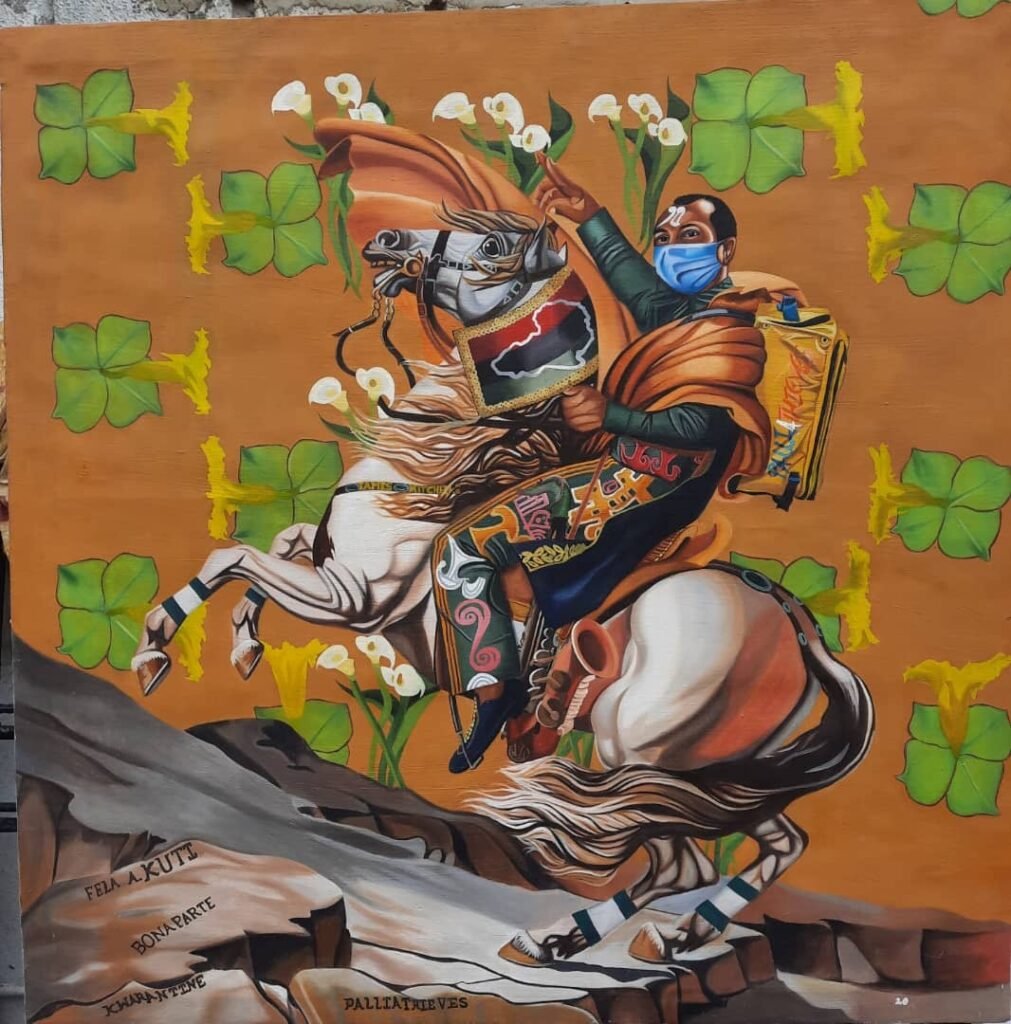
However, the work titled, Passion for All; Fela’s Call (2020). Produced during the EndSARS period by Mitchelle James Innocent has been declared missing.
This work has gained considerable recognition being that it’s tied to a bloody riot. Which took place at the Lekki Toll Gate in Lagos. A city hub, which was held by its neck until the government attended to the demands of the youth, only shortly after using gun power.
It’s no wonder the work has suddenly become a fascination. As Fela Kuti, the Afrobeat music legend was styled like Napoleon, who brought the republic to France after sacking the Royals.
While also depicting the strength of his words through the pan-Africanism visions he had. It’s no denial that Fela was a Nostradamus to the Africans. Because his painful lyrics which were told like prophecies have since become a gradual manifestation.
Before the work vanished, the painting had been publicly exhibited, including at the New Afrika Shrine during the 2024 Felabration and at Art Hotel Lagos.
As at its most recent exhibition in 2024, the piece was valued at ₦500,000 (equivalent to £250). More than monetary value, however, the work carried generational resonance — bridging classical European art history, Afrobeat resistance, pandemic satire, and youth protest culture.
The #EndSARS movement was rewriting the vocabulary of resistance for a new generation. Inside, on a 36 x 36 inch canvas, the spirit of Fela Anikulapo Kuti, the original musical insurgent was being resurrected.
On an equestrian oil painting that reimagines Fela not merely as musician, but as what the artist calls an “Emperor of Music.”
The work draws direct inspiration from Jacques-Louis David’s 1805 masterpiece depicting Napoleon Crossing the Alps. In David’s painting, Napoleon was likewise a heroic, commanding, immortalised in motion.
Mitchelle adopts this imperial visual language but replaces conquest with consciousness. On the rearing white horse sits Fela, not armed with a sword, but with his orange saxophone. His weapon which was his sound. His command the rhythm politicians hated. The protest was a battlefield of injustice.
Carved into the rocky terrain beneath the horse with layered inscriptions such as “FELA KUTI” “BONAPARTE” “KWARANTINE” “PALLIATHIEVES”
Mitchelle describes the loss as both personal and symbolic:
“This was not just a painting. It was created in the spirit of protest, in honour of the Emperor of Music who shaped my understanding of courage. Losing it feels like losing a chapter of my own creative identity.”
The artist is appealing to collectors, curators, galleries, and the public to report any sighting or attempted sale. Because sometimes, recovering art is not about reclaiming canvas. It is about restoring a voice.